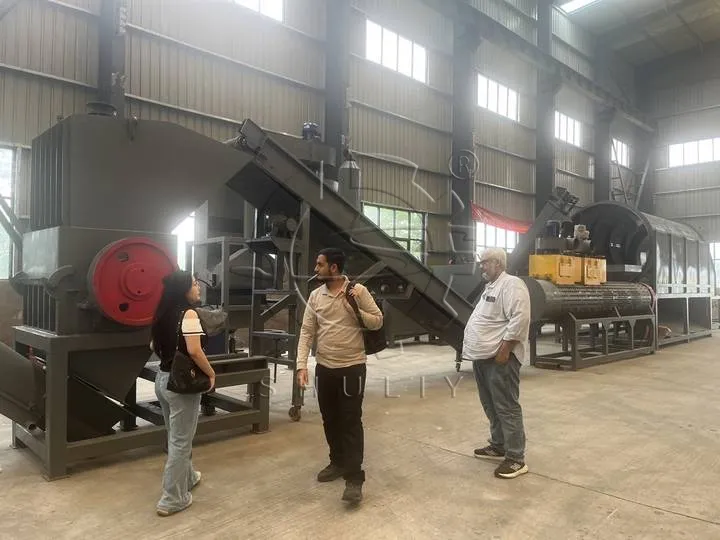
Last week, we had the pleasure of welcoming Juma and Emanuel to our factory in Zhengzhou. The two partners run a busy recycling plant in Dar es Salaam, Tanzania, and flew all the way to China with a very clear goal: finding a solid, dependable PET bottle recycling machine in Tanzania that can produce export-quality flakes without breaking down every other week.
If you have ever processed plastic bottles collected from unpaved roads and open markets in coastal East Africa, you know the daily headaches: sticky local labels that refuse to peel off, and thick layers of red sand that blunt ordinary blades in days. Juma and Emanuel had already tried using cheap, locally assembled dry shredders. The result? Dust everywhere, jagged flakes, and complaints from overseas buyers over high dirt and moisture levels. They knew that if they wanted to build a profitable PET bottle washing line in East Africa, they had to partner with an experienced plastic recycling machine manufacturer China who understands these exact ground realities.
Our sales manager, David, greeted them at the airport, treated them to a hearty local dinner, and sat down to hear about their workshop conditions back home. The next morning, we skipped the fancy showroom slides and headed straight to the heavy-duty assembly floor. Juma and Emanuel wanted to see the real steel, hear the motors run, and test how our machines handle truly dirty feedstock.
Shop Floor Audit: Engineering for Sandy, Heavy-Label Feedstocks
- Label Stripping Without Bottle Shattering
Manual de-labeling creates an immediate labor bottleneck. The clients inspected our continuous Máquina de desrotulagem de garrafas PET.
Unlike basic barrel strippers that pulverize thin-walled water bottles, Shuliy uses an internal rotor equipped with 100 interchangeable tungsten carbide alloy tool tips encased in an 8mm-to-10mm steel shell. The dynamic interaction peels off 98% of full-body shrink labels through rotary shear rather than direct impact, discharging whole, unbroken bottles. This leaves the bottle bodies intact so operators can easily spot and remove colored plastics downstream.
- Wet Crushing Against Abrasive African Soils
Processing dirty bottles through dry shredders generates airborne dust and dulls blades rapidly. The clients audited our heavy-duty PET crusher, focusing on its 30mm thick solid-steel housing and 40mm thick blade mounting discs.
David demonstrated our integrated wet crushing setup. Water introduced directly into the cutting chamber flushes out fine red soil and cools the cutting edges, preventing thermal plastic melting. The cutting geometry utilizes SKD11 tool steel blades set at a shearing scissor angle, keeping fines below 2%. To reduce reliance on imported spares, the team reviewed our optional 1.0-meter bed knife grinder, which allows mechanics to resharpen blade sets on-site.
- Caustic Glue Stripping and Thermal Drying
Export markets penalize discolored flakes caused by label adhesive. The clients inspected our high-temperature hot washer tank, which operates between 85°C and 95°C. Powered by a 15kw cycloidal drive, the internal paddle forces flakes through a sodium hydroxide solution, saponifying stubborn adhesives without degrading polymer viscosity.
Following multi-stage sink-float rinsing to eject floating polyolefin caps, the material enters our high-speed horizontal centrifugal dryer and hot air pipeline. The mechanical centrifuge drops surface water to 3%, and the subsequent hot-air pipe brings total moisture below 0.8%, meeting maritime shipping criteria.
Deploying a PET Bottle Washing Line in East Africa
Operating a PET bottle washing line in East Africa requires infrastructure-specific electrical engineering. To accommodate regional voltage drops, Shuliy’s electrical cabinets integrate thermal overload relays, phase-sequence monitors, and an automated PLC interlock system that shuts down upstream conveyors if a motor experiences a power surge.
By physically inspecting machine frame thicknesses, blade alloys, and thermal wash tanks, Juma and Emanuel finalized specifications for a 1,000 kg/h processing line. Investing in a properly configured Máquina de reciclagem de garrafas PET in Tanzania provides the operational durability needed to handle abrasive input materials and produce clean flakes that meet competitive global export standards.